top of page
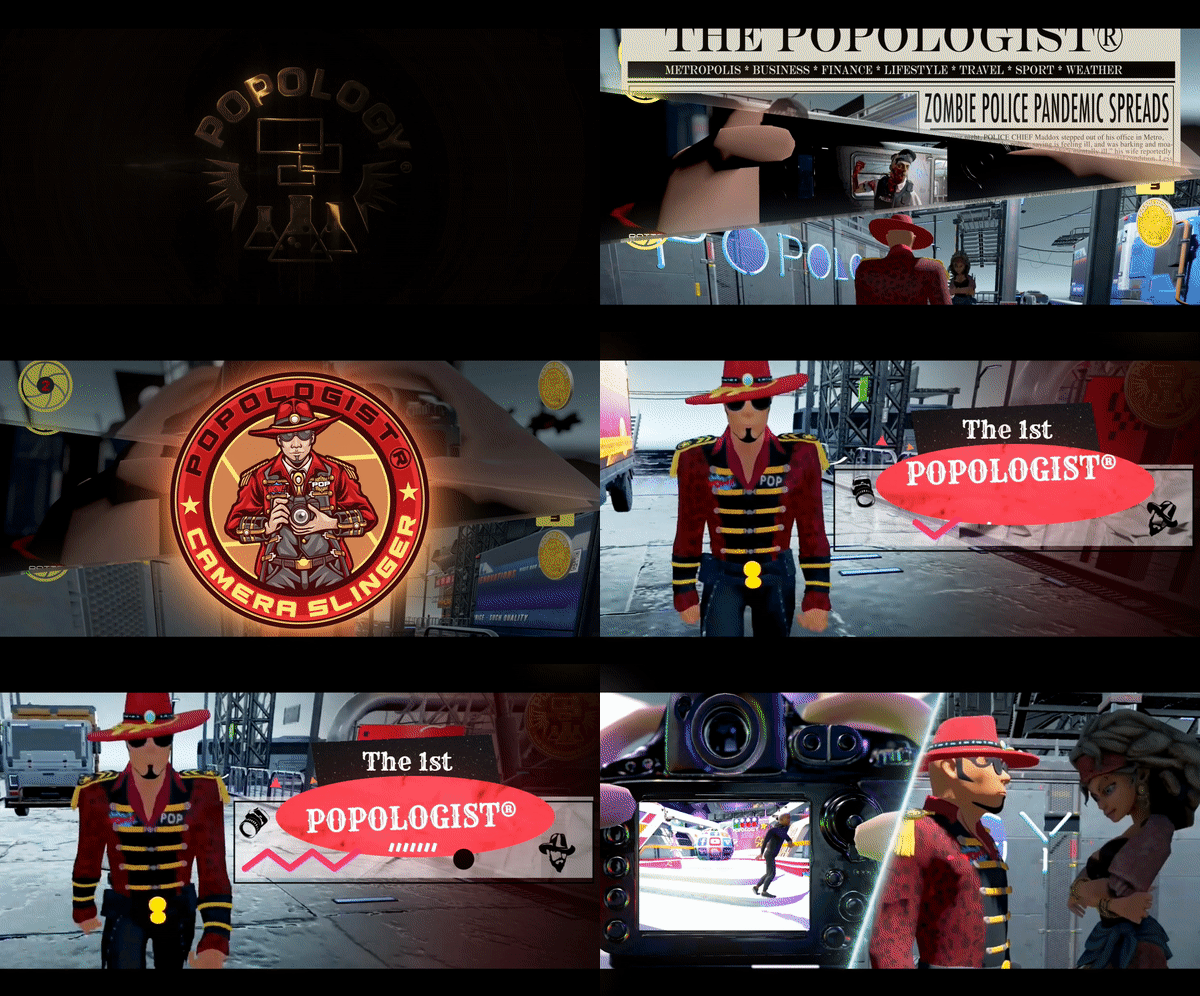
1st POPOLOGIST®
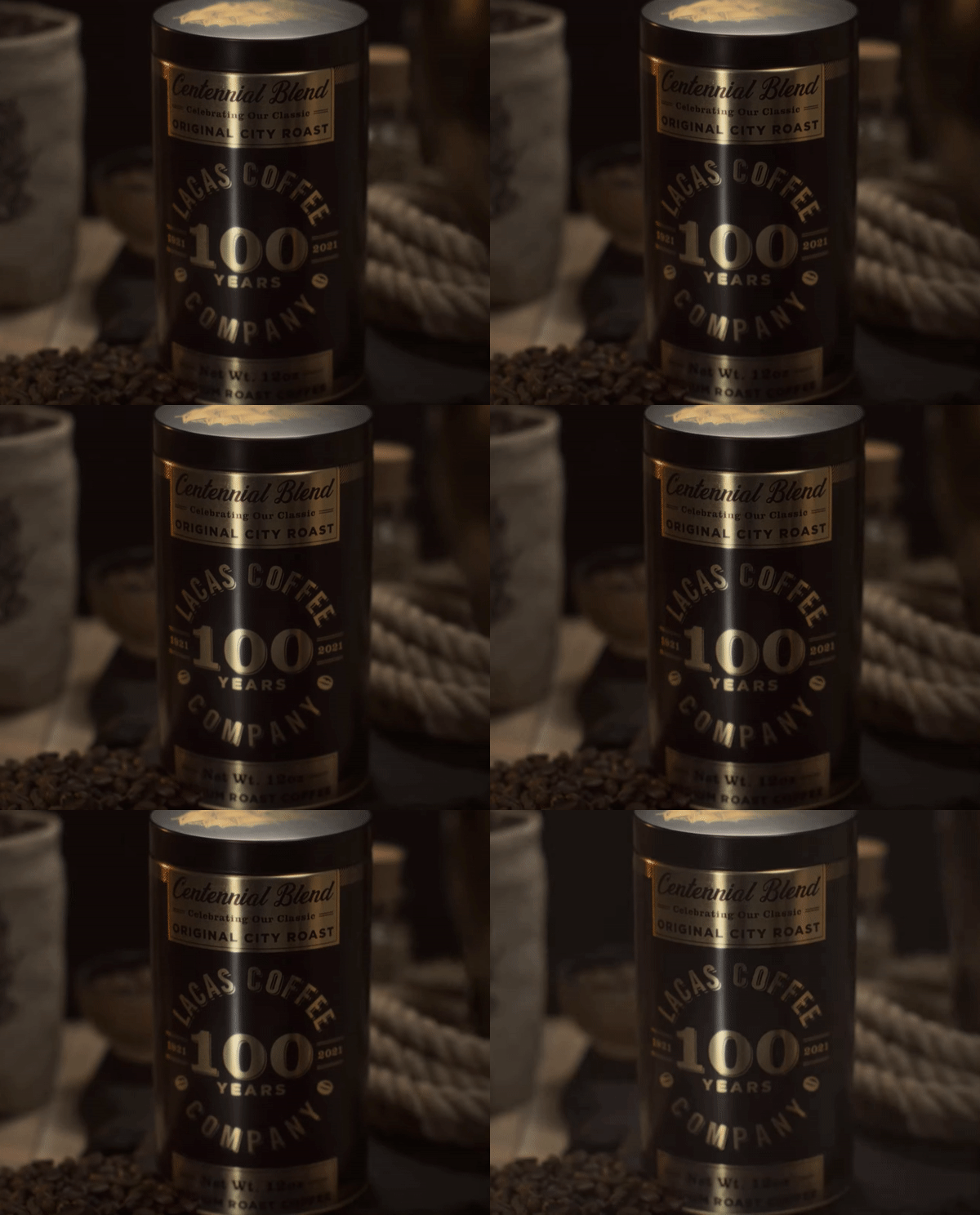
Lacas Coffee
Lacas Coffee
Credit Yak
Buy Your Swagg on POPOLOGIST®
The POPOLOGIST® Camera Slinger Video Game
POPOLOGY® Networks
1st POPOLOGIST® Pillow Swag
Science Under Nature
1st POPOLOGIST® Camera Slinger T Shirt
Color-Fuchsia Pink POPOLOGY® Underwear
Funky i Puppet


Partners, Friends & Family, POPOLOGIST® AMBASSADORS

We submitted POPOLOGY® as a demonstrable workshop at SXSW MUSIC & TECH FESTIVAL 2024. Please click the link and register to give us an UP-VOTE in PLEASE?

Starting today, the greater online community is invited to vote and share their input on your session idea through Sunday, August 20. The community's input will amount to 30% of the total score for your proposal. Your proposal will also be evaluated by the SXSW EDU Advisory Board (40%) and SXSW EDU staff (30%) during this time.

The community will have the opportunity to "Vote Up" or "Vote Down" on all session ideas (votes will be kept private) and add comments to each page. We encourage you to use this commenting feature to expand on your session idea, make note of any updates or changes, and even engage with the voting community.

Anyone with internet access can cast a single vote for as many proposals as they would like upon creating a PanelPicker account. (You must signup to vote)

Please make a comment with your Up-vote!

This is the access link to find POPOLOGY®


We are thrilled to announce that we are a proud recipient of the Upstate California Creative Corps Grant!


🌟🎨 This prestigious grant recognizes our dedication to promoting arts and creativity in our community. #ArtsCa#UpstateCreativeCorp Thanks to this incredible support, we'll be able to take our creative endeavors to new heights, bringing you more

captivating content and imaginative experiences. 🚀 Stay tuned for exciting updates as we embark on this enriching journey! We couldn't have achieved this without the support of our amazing fans and partners. Your passion for the arts inspires us every day.

🙌❤️ Together, we'll continue to create magic and make a positive impact on the world around us. Thank you, #UpstateCaliforniaCreativeCorps, for believing in our vision and making it possible for us to bring the arts to life in Butte County, CA. 🙏🎉


The Law Of Reverse Effect!

The Law of Reverse Effect suggests that “the greater the conscious effort, the less the subconscious response” or “whenever the will (conscious mind) and imagination (subconscious) are in conflict, the imagination (subconscious) always wins.”

Wu wei (simplified Chinese: 无为; traditional Chinese: 無為; pinyin: wúwéi) is an ancient Chinese concept literally meaning "inexertion", "inaction", or "effortless action"[a].[1][2]Wu wei emerged in the Spring and Autumn period. With early literary examples in Confucianism, it is an important concept in Chinese statecraft[3] and Taoism. It was most commonly used to refer to an ideal form of government,[4] including the behavior of the emperor. Describing a state of personal harmony, free-flowing spontaneity and laissez-faire, it generally also more properly denotes a state of spirit or mind, and in Confucianism accords with conventional morality.


Theories Galore

One of the very best and worst aspects of modern-day sport psychology is the sheer number of theories we have. Boy, are there a lot to choose from. The upside of having so many concepts to draw from is it’s rare we encounter a challenge with no empirical guidance. Struggling with your confidence? No worries, we’ve got you covered. Finding yourself in the middle of a motivation rut during the middle of the season? Easy Peasy, we’ve got about a dozen processes that are specifically designed to help with exactly that.

But of course, there is a downside as well. Information overload! Due in part to the fact that we employ quite a number of sport psychologists and performance psychologists and therefore are ethically obliged to agree with one another to a certain degree, we have always been interested in organising these theories in some way.


A Theory For All The Theories

By organising, I mean sorting them into different types so to speak. For example, which of them actually contain useful and useable processes. When you examine many of these models properly you’ll be surprised how many don’t actually contain applied advice.

Let’s take the Theory of Internal And External Motivation as an example. It is a great concept but somewhat lacking when it comes to tried and tested ideas on how to actually be more internally motivated for example. So, giving a workshop on types of motivation to a group of athletes rarely has any impact on their actual motivation. And then there are some theories that virtually nobody has come across. And yet without too much creativity, they have so much potential benefit it’s not funny.


Have You Heard About The Law of Reverse Effect?

One of these is The Law of Reverse Effect or sometimes called The Law of Reversed Effect (with a ‘d’ at the end of reverse) or The Law of Reverse Effort or The Backwards Law. Classic psychology, we can’t even agree on the name of the thing! Speaking of which have you voted yet for what you believe ought to be the correct spelling of sport(s) psychology from now? If not you can vote here to have your say.

Anyway, The Law of Reverse Effect suggests that “the greater the conscious effort, the less the subconscious response”or “whenever the will (conscious mind) and imagination (subconscious) are in conflict, the imagination (subconscious) always wins.”

Non-psychobabble takeaway? At some point, when your motor skills are automated enough (muscle memory has been established) then trying really hard to hit the ball, stick the dismount or make the right incision (surgeon) will actually have the reversed effect and make you worse. It would be like trying to sneeze or laugh better.


Neuroscience Time

How is this possible? Surely putting in the maximum effort is universally beneficial, right? Wrong.

In order to explain we need to tap into a little bit of neuroscience. When you complete a body movement your basal ganglia and cerebellum attempt to learn how it was done. The more you repeat the same movement the stronger this memory of the muscles becomes. After a while, the movement becomes automatic. In other words, it can be done and prefers to be done without conscious effort.

Thinking about how to complete this body movement acts as a circuit breaker for this automatic process. The muscle memory is blocked and your body goes back into a kind of novice/learning mode. The prefrontal cortex overrides the basal ganglia and cerebellum. As you can imagine in the work that we do this is very useful information. It informs us that it is not that trying too hard is the problem but rather what type of effort is best avoided.

Have You Worked It Out Yet?

That’s right, it is the mental effort related to the technical aspects of what you do. The biomechanics of the putt, punt, pass or pivot for example. In essence, the very last thing that we want to be thinking about when you are lining up to take the crucial penalty is how to kick the soccer ball.

So if we spare ourselves from the technical or biomechanical elements of effort when we are under pressure to perform then what does that leave us with? It leaves us with mental effort about something other than technique. Basically, mental effort about something mental or something tactical.

For example, saying to yourself “trust your processes or stick to your processes”doesn’t interfere with the neurones involved in automatic muscle memory. So these cognitions can coexist quite happily with allowing your body just to do what it’s learnt how to do.

The same applies to reminding oneself about tactical aspects. Let’s use the previous example about taking a penalty in soccer/football. The decision about where to aim the shot is both necessary and non-interfering of muscle memory. These mental and tactical endeavours are already occurring in the conscious front part of the brain. Therefore they are by their very nature completely out of the way of the basal ganglia and cerebellum. No short-circuiting is taking place, not even remotely. Have a look at the below slice of the brain and note where they are located.


Pay Per View Live Events
Fiverr
Join Steam buy the POPOLOGIST® Camera Slinger Video Game
Camera Slinger Promo
rBeatzRadio_Final (All) NEW-03.png
POPOLOGIST® Tim Bennett and his new Children's Book
The Adventures Of DogShoe & The Bakery Gang
POPOLOGIST® Coffee Mug
Black POPOLOGIST® Hoodie
Livestream Marathon
POPOLOGIST® White Coffee Mug
Guitar Center promoted on POPOLOGIST® Website
The 1st POPOLOGIST Camera Slinger Mascot

© 2024 COPYRIGHT  POPOLOGY® & POPOLOGIST®

215-880-5928

  • Facebook
  • Twitter
  • YouTube
  • Pinterest
  • Instagram
bottom of page