top of page
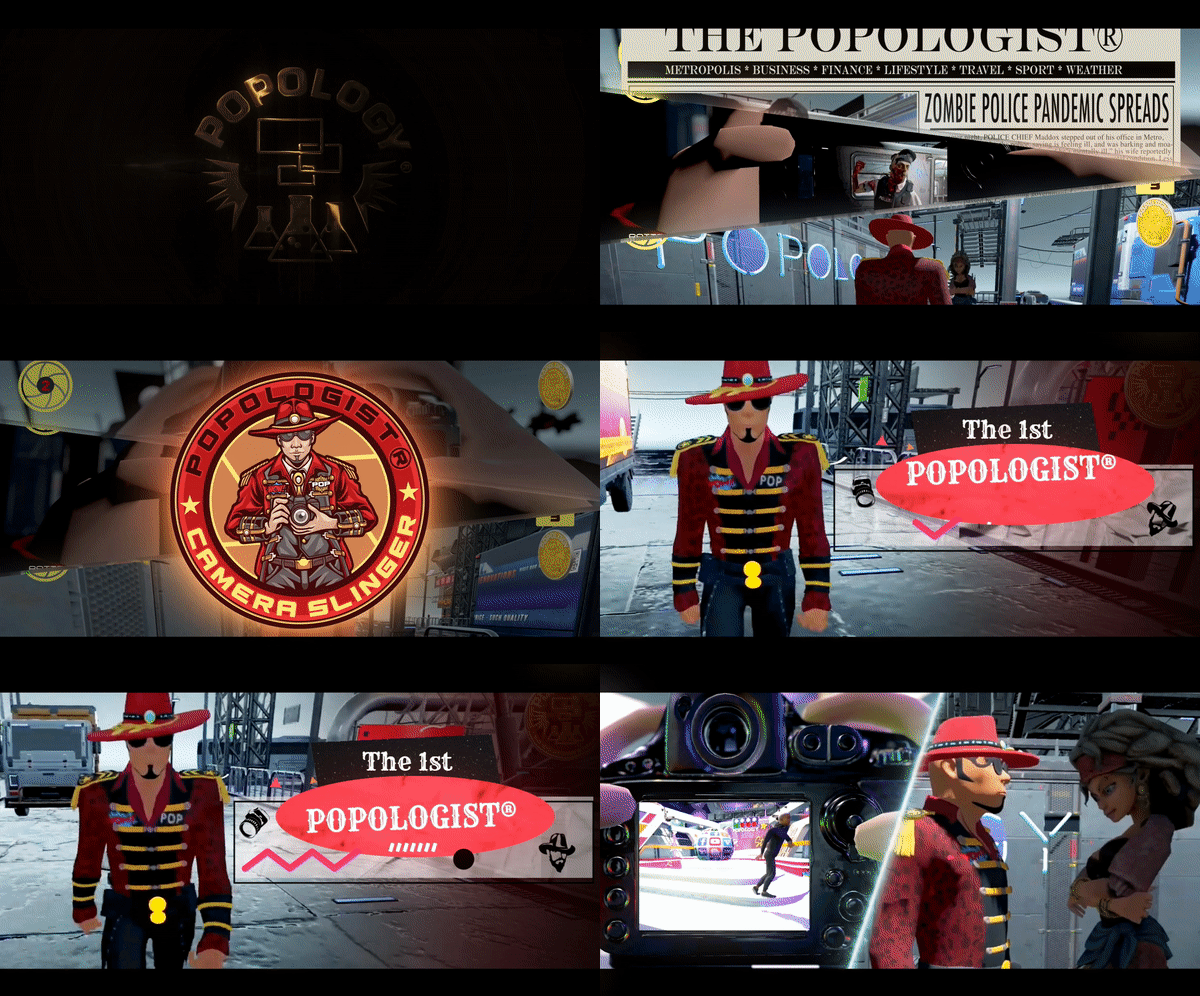
1st POPOLOGIST®
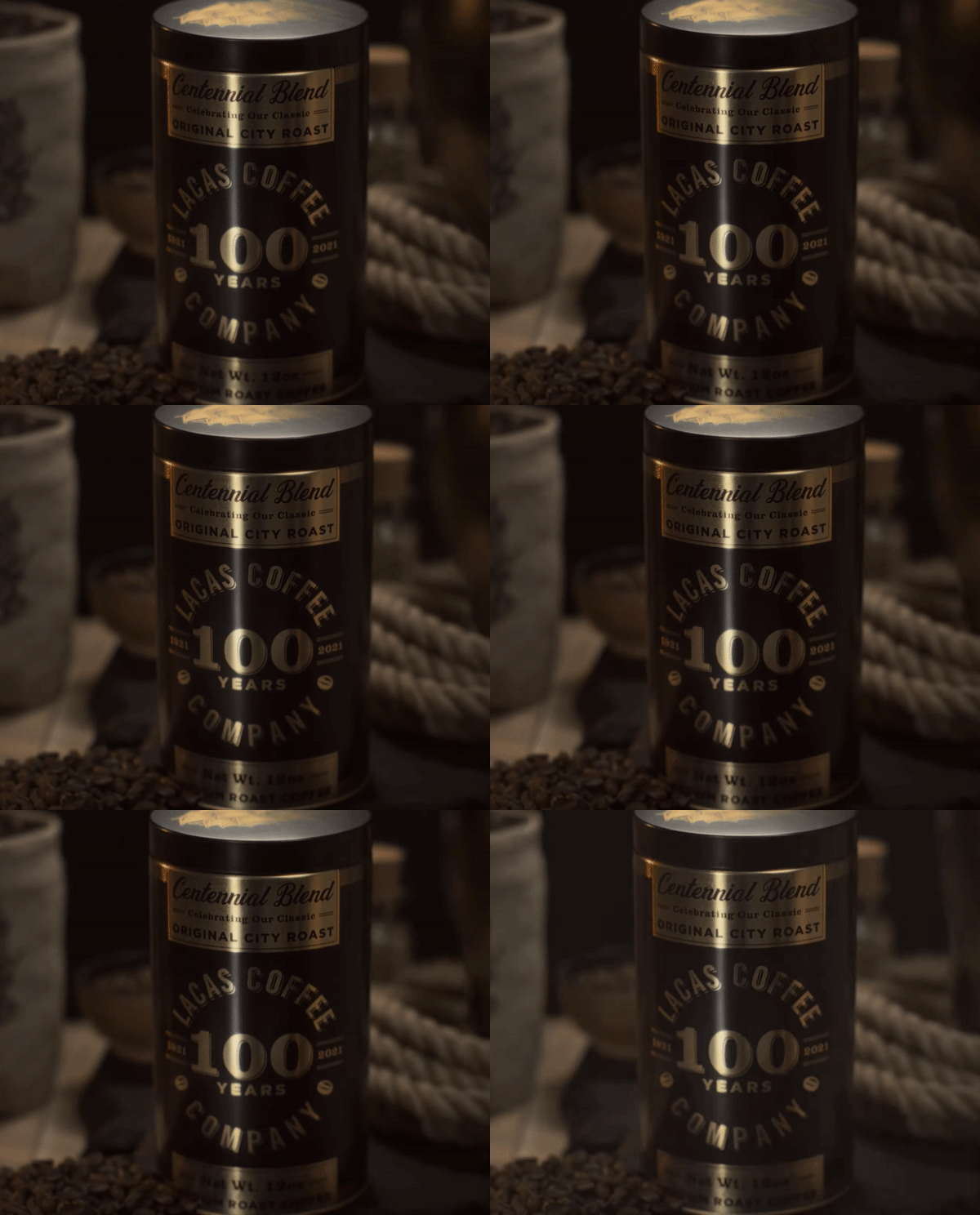
Lacas Coffee
Lacas Coffee
Credit Yak
Buy Your Swagg on POPOLOGIST®
The POPOLOGIST® Camera Slinger Video Game
POPOLOGY® Networks
1st POPOLOGIST® Pillow Swag
Science Under Nature
1st POPOLOGIST® Camera Slinger T Shirt
Color-Fuchsia Pink POPOLOGY® Underwear
Funky i Puppet

ree

Yoda's Bizarre Manner of Speaking in Star Wars, Explained!


Yoda's speech patterns have confused fans for years. So, here's the official reason he speaks backward, according to George Lucas and Frank Oz.


ree

While Obi-Wan, Anakin and Luke are the most important Jedi inStar Wars, there are plenty of other impressive Jedi. The prequels did a great job of elaborating on some of those background figures, and recent content has doubled down on that sentiment. Jedi like Plo Koon, Ki-Adi-Mundi and Kit Fisto all played prominent roles in the successes and failures of the Jedi Order. Yet, it was always Grandmaster Yoda who had the biggest impact on everything Jedi-related in Star Wars.


Yoda was a legendary Jedi Master and stronger than most in his connection with the Force. Small in size but wise and powerful, he trained Jedi for over 800 years, playing integral roles in the Clone Wars, the instruction of Luke Skywalker, and unlocking the path to immortality.


Yoda was first introduced in Star Wars: Episode V - The Empire Strikes Back, and even though he wasn't the warrior that Luke expected, Yoda proved his power and wisdom in the Force. Having seen that in the original trilogy, fans were excited to see Yoda put his prowess on display during the prequels. While his green lightsaber and Force skills were impressive, it was worth noting that Yoda still spoke with a bizarre, reverse syntax. It wasn't a habit that Yoda picked up on Dagobah during his exile, and it wasn't something he did especially for Luke. So, here's why Yoda spoke backward.


ree

George Lucas Created Yoda's Speech For Practicality


The first time hearing Yoda's speech patterns is confusing for anyone. All the words are there, but it's straight-up backward. It makes listeners focus, and it turns out that was exactly the point. George Lucas wanted viewers (and characters in the films) to hone in on what Yoda was saying because he was so full of wisdom. However, Yoda's speech patterns weren't just to make viewers focus, it was also designed to make their lives easier. Here's a quote from Paul Duncan's 2018 guide book The Star Wars Archives. Asked how he came up with Yoda's language, Lucas said:


"Mostly we had these strange languages and voices that were created out of foreign languages. I didn't want to go through a whole movie where everybody is reading subtitles. He had a lot of dialogue. So, I had to come up with a language that was alien, but still understandable. So, I reversed everything around. The language was designed to make you focus on the boring, philosophical lessons."

Thus, Yoda's bizarre way of speaking was designed to highlight what he was saying. Yet it was also designed to make sure that viewers weren't stuck reading subtitles the whole time. That way, Yoda could sound like an alien while still technically speaking English.


Yoda's Weird Speech Was a Conscious Choice For Him


George Lucas' comments make it seem like Yoda's speech patterns were a natural thing for him. However, the original Yoda had a different idea. In a recent interview, Dave Filoni (who was explaining why Yaddle doesn't speak like Yoda) recalled a conversation with Frank Oz. He said, "Frank Oz told me once that Yoda speaks that way specifically in honor of his own master. That was what he had thought about it." Granted, actors regularly come up with backstories for their characters that may or may not be considered canon. But Filoni's comments and the way that Yaddle speaks could prove Frank Oz correct.

Yoda's master isn't a part of canon, but in Legends, he was named N'Kata Del Gormo. He was a Hysalrian Jedi Master who was seemingly in the middle of an exile when Yoda and a friend crash-landed on his planet. In an obvious parallel to Yoda training Luke on Dagobah, Master Kel Gormo trained Yoda and his friend, who later departed for the Jedi Temple on Coruscant and left the ancient Jedi to his exile.

If Yoda's master did teach Yoda to use a backward way of speaking, it clearly helped him become a better Jedi. That's why Yoda also adopted a weird way of speaking -- so he could help train countless other Jedi and impart his wisdom to them.


Yoda's species


"Small, green, and wrinkly with pointy ears."―Ezra Bridger talking about Kanan Jarrus' description of Yoda

The species to which the Jedi Grand Master Yoda belonged was ancient and shrouded in mystery. Members of this species were rarely seen anywhere in the galaxy. The few members of this species seen in the galaxy were all Force-sensitive, and the species' homeworld and name were unknown.


in: Pages needing citation, Canon articles, Semi-protected pages, and 5 more Yoda's species The species had two known sexes: male and female. Members of the species were small in size, roughly comparable to that of a human child, with green skin, large eyes, and long pointed ears. Their three-fingered hands ended in claws. The species were suggested to mostly have a carnivorous diet, with a preference towards catching and devouring live amphibians whole. Their ears were expressive, curling, and unfurling in accordance with their emotions.


Members of the species were capable of growing thin hair, with shades varying from auburn to white being documented, females having longer and thicker hair than males. The species had a very long life expectancy, spanning at least several centuries; Yoda lived nearly a thousand years before dying of old age,[6] and they aged very slowly, remaining in infancy for at least fifty standard years.[5] Even at this stage of life, certain Force-sensitive individuals of this species could use Force powers such as telekinesis and Force healing;[10][11] they were also capable of complex thought processes, and could understand speech and communicate via the Force at this age.[12] Despite their slow aging for the first five decades of life,[5] members of the species reached maturity by their hundredth year, as exemplified by the Jedi Yoda, who began training other Jedi when he was about one hundred years old. Society and culture

Due to the rarity of the species in the wider galaxy, little was known about them except that the species was ancient and shrouded in mystery. Members of the species were capable of speaking Galactic Basic Standard, although Yoda used a distinctive and archaic syntax.

History

Yoda, Grand Master of the Jedi

"Do, or do not. There is no try."―Yoda to Luke Skywalker —

Yoda served as Grand Master of the Jedi Order when he was almost nine centuries old.

Yoda, the last Grand Master of the Jedi Order prior to its fall at the end of the Clone Wars, was a member of the species born around the standard year896 BBY. He began training other Jedi when he was around a century old. Over the centuries, Yoda, who never revealed what his homeworld was,trained many Jedi before eventually becoming the Grand Master of the entire order.[3] One of his final Padawans was Dooku, a human male who eventually left the Order and fell to the dark side, becoming the Sith Lord Darth Tyranus,


When Sidious, publicly Supreme Chancellor Palpatine, revealed himself and issued Order 66, which killed most Jedi across the galaxy, Yoda was one of the few survivors, returning to Coruscant and dueling the self-declared Galactic Emperor; however, Yoda was forced to retreat. Yoda subsequently went into hiding on the remote planet Dagobah, eventually training one final student, Luke Skywalker, during the Galactic Civil War to overthrow Sidious' Galactic Empire.[1] Yoda died on Dagobah shortly before the Battle of Endor, afterwards becoming a Force spirit.[16]

Yaddle of the Jedi Council

"Yaddle is known for being very kind and quiet, but on the other hand possesses some of the deadliest Force powers."


ree


This year the band LOS LOBOS is celebrating their 50th year together and are thrilled to be touring again, especially with a return to the Pacific Northwest. “We always enjoy coming back to the Northwest and had some fun shows in the Puget Sound area over the years,” Steve says. “I had a personal connection to Olympia when my daughter went to school at evergreen, so I am looking forward to coming back to my favorite spots like for some batdorf and bronson.”


In 1973, Los Lobos entered the music scene, boasting a brave new sound while capturing their Mexican heritage. Over the years, they developed their sound by incorporating elements of rock n’ roll, blues, country, and Latin music. “We aren’t easily pigeonholed outside of our Latino heritage,” shares Los Lobos Saxophonist and Keyboardist Steve Berlin. “In many respects the band never changed as we have gone off on our own way to invent something that we own and I don’t think we really sound like anybody else. What we do is unique and we take a lot of pride in that.” Los Lobos features Steve Berlin on saxophone and keyboard, David Hidalgo as singer, guitarist, and primary songwriter, Louie Perez on drums, guitar, and songwriting, Cesar Rosas as the third guitarist, and Fredo Ortiz on drums. Unfortunately, their bass player Conrad Lozano won’t be touring with the band this year, so David Hidalgo’s son Vincent Hidalgo will be taking the stage with them.~~

LOS LOBOS came thru and did the damn thang!! When you get the chance, please go check these guys out! even if you've seen them live before, go see them again and again and again.... Bravo los lobos!!!


ree

The hit film “La Bamba” rocketed them to stardom with their beloved covers of Ritchie Valens’ songs. The soundtrack for the movie featured many hits, with the title track becoming number one for the band. “It was surprising to say the least,” Steve recalls. “When we were working on ‘La Bamba,’ it at no time seemed like it was going to be a hit movie. It was just timed right, it was soulful, and it was the summer hit so we were it for that year. It changed everything.” Though “La Bamba” brought amazing new opportunities, the band really worked to establish their own separate sound and fanbase through their unique sound.


ree


ree

ree

"La Bamba" (pronounced [la ˈβamba]) is a Mexican folk song, originally from the state of Veracruz, also known as "La Bomba". The song is best known from a 1958 adaptation by Ritchie Valens, a Top 40 hit in the U.S. charts. Valens's version is ranked number 345 on Rolling Stone magazine′s list of the 500 Greatest Songs of All Time.

"La Bamba" has been covered by numerous artists, notably by Los Lobos whose version was the title track of the 1987 film La Bamba, a bio-pic about Valens; their version reached No. 1 in many charts in the same year. The Belgian Electronic band "Telex", the trio who made the worldwide successful "Moskow Diskow," also created a downbeat electronic cover of it, which is the final track in their final album "How Do You Dance?".


Traditional Versions

"La Bamba" is a classic example of the son jarocho musical style, which originated in the Mexican state of Veracruz, and combines Spanish, indigenous, and African musical elements. The song is typically played on one or two arpa jarochas (harps) along with guitar relatives the jarana jarocha and the requinto jarocho. Lyrics to the song vary greatly, as performers often improvise verses while performing. However, versions such as those by musical groups Mariachi Vargas de Tecalitlan and Los Pregoneros del Puerto have survived because of the artists' popularity. The traditional aspect of "La Bamba" lies in the tune, which remains almost the same through most versions. The name of the dance referenced within the song, which has no direct English translation, is presumably connected with the Spanish verb "bambolear", meaning "to sway", "to shake" or "to wobble". In one traditional version of this dance performed at weddings and ballet folklórico shows, couples utilize intricate footwork to create a bow signifying their union.

Early Recordings

"La Bamba" has its origin in the state of Veracruz, Mexico. The oldest recorded version known is that of Alvaro Hernández Ortiz, who recorded the song with the name of "El Jarocho". His recording was released by Victor Records in Mexico in 1938 or 1939, and was reissued on a 1997 compilation by Yazoo Records, The Secret Museum of Mankind Vol. 4.

According to a 1945 article in Life, the song and associated dance were brought "out of the jungle" at Veracruz by American bandleader Everett Hoagland, who introduced it at Ciro's nightclub in Mexico City. It became popular, and the song was adopted by Mexican presidential candidate Miguel Alemán Valdéswho used it in his successful campaign. Later in 1945, the music and dance were introduced at the Stork Club in New York City by Arthur Murray.


A popular version by Andrés Huesca (1917–1957) and his brother Victor, billed as Hermanos Huesca, was issued on Peerless Records in Mexico around 1945–46. Huesca re-recorded the song for RCA Victor in 1947, and the same year the song featured as a production number in the MGM musical filmFiesta, performed by a group called Los Bocheros. The song was featured in the 1946 Mexican movie Rayando el Sol starring Pedro Armendáriz.[citation needed]

The Swedish-American folk singer William Clauson recorded the song in several languages in the early and mid-1950s. He claimed to have heard the song in Veracruz, and in performance slowed down the tempo to encourage audience participation. Another version, "somewhat bowdlerized", was recorded by Cynthia Gooding on her 1953 Elektra album, Mexican Folk Songs.


ree
Sign Up POPOLOGIST®!

How To Add Value:

Before you can purchase this POPOLOGY® Crypto Trading Card, Publish your knowledge or POPcontent™ bubble to the appropriate & categorical topic of chosen artist Crypto Trading Card. How do you know the data you propose to add to the blockchain biopic of this Artist?Authentication, and great details add great value to this Fan portal. Open a POPOLOGY® Networks Digital Wallet & start making POPtoken™ & POPOLOGY® Coin™, from your mobile phone, or computer world wide. If your POPcontent™ is not validated with footnotes, photos, or articles, it will be POPPED, and no longer visible.

With POPOLOGY® you can do blockchain ledgering to your content: write posts, follow members, manage comments & more.

Add media to your POPOLOGY® Crypto Trading Card!

When creating your POPcontent™ you can:

  • Upload images or GIFs

  • Embed videos and music

  • Create galleries to showcase a media collection


Hashtag your posts

Love #LosLobos Good news! #USTOO!

You can add tags throughout your posts to reach more people. So go ahead and #POPOLOGIZE away!


ALL CRYPTO FUNDS BUILD THE POPOLOGY® NETWORKS APPORTUNITY!

Love #LosLobos Good news! #USTOO!


Tip:

You can ASSIGN any member of THIS PORTAL your POPOLOGY® Crypto Trading Card as a contributor, (without purchase) so they can add TO THE BOOK OF POP PAGES for your crypto card value to raise. Adding multiple contributors is a great way to grow your content and keep it fresh and diversified.


ree


The Script OF SNOOP DOGG!


"Are you tired of constantly switching between multiple social media and search engine platforms to gather information or find content that interests you? Well, POPOLOGY has got you covered. With POPOLOGY, you can integrate up to 25 of your trusted social media and search engine memberships for data mining rewards and the best in content discovery inside the immersive popsphere. A Video MetaSearch Engine."


"With POPOLOGY®, you can easily connect your accounts from platforms such as Facebook, Twitter, Youtube, Daily Motion, Instagram, Tiktok, Google, Bing, and many more. Once connected, POPOLOGY uses cutting-edge data mining algorithms to analyze your activity across all platforms and deliver personalized recommendations for curating content that aligns with your interests. Make a dope ass popcast blockchain media stream as a POPOLOGIST! You can even pick the advertising sponsors you want from our popmercial gallery to reach thousands to millions of new audience members for your Citizen journalism report in what is popular to you!


"The POPOLOGY® dashboard provides an easy-to-use interface that allows you to manage all of your connected accounts in one place. You can also track your pop cast progress and earn rewards for using the platform. These rewards can be redeemed for discounts, cash back, or other valuable incentives. Also be straight up popular with your audience, cause they get rewarded for watching your popcast too! "But that's not all. With POPOLOGY, you also gain access to the immersive popsphere Video MetaSearch Engine. Yo! This powerful tool enables you to search for video content across multiple platforms simultaneously.


Whether you're looking for the latest news, educational resources, or your favorite Snoop dogg music videos, POPOLOGY is all that indeed! "With the popsphere workspace, you can filter search results by source, category, date, and other parameters to quickly find the video content you need. And because the popsphere aggregates content from your multiple sources, you're more likely to discover hidden gems that you wouldn't find otherwise.” No doubt.


"So, whether you're a content creator looking for inspiration, or a homie looking for the best content on the web, POPOLOGY Networks can help. With their powerful data mining algorithms and immersive interface, you'll never have to switch between multiple platforms again." "So what are you waiting for my brothers and sisters? Sign up for POPOLOGY today and start discovering the best content the web has to offer.” fo shizzle my nizzle


Pay Per View Live Events
Fiverr
Join Steam buy the POPOLOGIST® Camera Slinger Video Game
Camera Slinger Promo
rBeatzRadio_Final (All) NEW-03.png
POPOLOGIST® Tim Bennett and his new Children's Book
The Adventures Of DogShoe & The Bakery Gang
POPOLOGIST® Coffee Mug
Black POPOLOGIST® Hoodie
Livestream Marathon
POPOLOGIST® White Coffee Mug
Guitar Center promoted on POPOLOGIST® Website
The 1st POPOLOGIST Camera Slinger Mascot

© 2024 COPYRIGHT  POPOLOGY® & POPOLOGIST®

215-880-5928

  • Facebook
  • Twitter
  • YouTube
  • Pinterest
  • Instagram
bottom of page