







- POPOLOGY® Networks
- Jul 28, 2021
- 5 min read

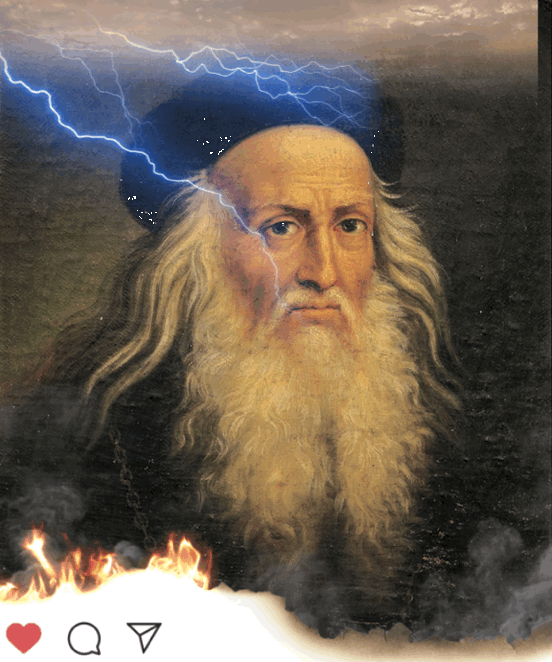
The Italian polymath Leonardo da Vinci (1452–1519) left thousands of pages of writings and drawings, but rarely made any references to his personal life.[1] The resulting uncertainty, combined with mythologized anecdotes from his lifetime, has resulted in much speculation and interest in Leonardo's personal life. Particularly, his personal relationships, sexuality, philosophy, religion, vegetarianism, left-handedness and appearance.
Leonardo has long been regarded as the archetypal Renaissance man, described by the Renaissance biographer Giorgio Vasari as having qualities that "transcended nature" and being "marvellously endowed with beauty, grace and talent in abundance".[2] Interest in and curiosity about Leonardo has continued unabated for five hundred years.[3] Modern descriptions and analysis of Leonardo's character, personal desires and intimate behavior have been based upon various sources: records concerning him, his biographies, his own written journals, his paintings, his drawings, his associates, and commentaries that were made concerning him by contemporaries.


Biography
Leonardo was born to unmarried parents on 15 April 1452, "at the third hour of the night"[4] in the Tuscan hill town of Vinci, in the lower valley of the Arno River in the territory of the Republic of Florence. He was the out-of-wedlock son of the wealthy Messer Piero Fruosino di Antonio da Vinci, a Florentine legal notary, and an orphaned girl, Caterina di Meo Lippi.[5][6][7] His full birth name was "Leonardo di ser Piero da Vinci", meaning "Leonardo, (son) of (Mes)ser Piero from Vinci". The inclusion of the title "ser" indicated that Leonardo's father was a gentleman.
childhood home in Anchiano
Leonardo spent his first five years in the hamlet of Anchiano in the home of his mother, then from 1457 lived in the household of his father, grandparents and uncle, Francesco, in the small town of Vinci. His father had married a sixteen-year-old girl named Albiera;[8] Ser Piero married four times and produced children by his two later marriages.[9] Leonardo's seven brothers were later to argue with him over the distribution of his father's estate.
At the age of about fourteen Leonardo was apprenticed by his father to the artist Andrea del Verrocchio. Leonardo was eventually to become a paid employee of Verrocchio's studio. During his time there, Leonardo met many of the most important artists to work in Florence in the late fifteenth century including Sandro Botticelli, Domenico Ghirlandaio and Pietro Perugino. Leonardo helped Verrocchio paint The Baptism of Christ, completed around 1475. According to Vasari, Verrocchio, on seeing the beauty of the angel that his young pupil had painted, never painted again.[10]
Burial place of Leonardo da Vinci,
in the Chapel of Saint-Hubert, Château d'Amboise, France
Florence was at this time a Republic, but the city was increasingly under the influence of a single powerful family, the Medici, led by Lorenzo de' Medici, who came to be known as "Lorenzo the Magnificent". In 1481 Leonardo commenced an important commission, the painting of a large altarpiece for the church of San Donato in Scopeto. The work was never completed. Leonardo left Florence and travelled to Milan carrying a gift from Lorenzo to the regent ruler, Ludovico Sforza. He was employed by Ludovico from 1481 to 1499, during which time his most important works were the Virgin of the Rocks, the Last Supper and a huge model of a horse for an equestrian monument which was never completed. Other important events during this time were the arrival in his studio of the boy Salaì in 1490, and in 1491 the marriage of Ludovico Sforza to Beatrice d'Este, for which he organized the celebrations. When Milan was invaded by the French in 1499, Leonardo left and spent some time in Venice, and possibly Rome and Naplesbefore returning to Florence.[11]
In Florence, Leonardo lived at premises of the Servite Community, and at that time drew the large cartoon for the Madonna and Child and St Anne, which attracted a lot of popular attention. He is also reported to have had a job to do for King Louis XII of France.[11] From 1506 Leonardo was once again based mostly in Milan. In 1507 Francesco Melzi joined his household as an apprentice, and remained with him until his death. In 1513 Leonardo left Milan for Rome and was employed by the Medici family. In 1516 he went to France as court painter to King Francis I.[11] The king gave the chateau of Clos Lucé as his home and regarded him with great esteem. It is said that the king held Leonardo's head as he died. Leonardo is buried in the Chapel of Saint-Hubert adjacent to the Château d'Amboise in France.
Character
Leonardo da Vinci was described by his early biographers as a man with great personal appeal, kindness, and generosity. He was generally well loved by his contemporaries. According to Vasari, "Leonardo's disposition was so lovable that he commanded everyone's affection". He was "a sparkling conversationalist" who charmed Ludovico Sforza with his wit. Vasari sums him up by saying:
... his magnificent presence brought comfort to the most troubled soul; he was so persuasive that he could bend other people to his will. ... He was so generous that he fed all his friends, rich or poor... Through his birth Florence received a very great gift, and through his death it sustained an incalculable loss.
Vasari also says:
In the normal course of events many men and women are born with various remarkable qualities and talents; but occasionally, in a way that transcends nature, a single person is marvellously endowed by heaven with beauty, grace and talent in such abundance that he leaves other men far behind... Everyone acknowledged that this was true of Leonardo da Vinci, an artist of outstanding physical beauty who displayed infinite grace in everything he did and who cultivated his genius so brilliantly that all problems he studied were solved with ease.
While painting The Last Supper, Leonardo wrote, "Wine is good, but water is preferable at table. ... Small rooms or dwellings set the mind in the right path, large ones cause it to go astray. ... If you want money in abundance, you will end by not enjoying it." He also wrote, "He who wishes to become rich in a day is hanged in a year."[12]
Some of Leonardo's philosophies can be found in a series of fables he wrote for the court of Ludovico Sforza. These were presented as jests (labelled 'prophecies') in which he told a riddle and made his audience guess the title.[13] Prevalent themes include the dangers of an inflated sense of self-worth, often as described in opposition to the benefits that one can gain through awareness, humility and endeavour. Leonardo also had a distinctive sense of humour, showing newfound friends a lizard he had decorated in scales, a horn and beard made from quicksilver to surprise them,[14] and describing a practical joke in his Treatise on Painting:
If you want to make a fire which will set a hall in a blaze without injury, do this: first perfume the hall with a dense smoke of incense or some other odoriferous substance: it is a good trick to play. ... then go into the room suddenly with a lighted torch and at once it will be in a blaze.[15]
DPFxS4xdkk9VzHgN2FcHsYUZPgzLbwTB5LeV9SfzKDAP https://waves.exchange



%20NEW-03.png)


