top of page
1st POPOLOGIST®
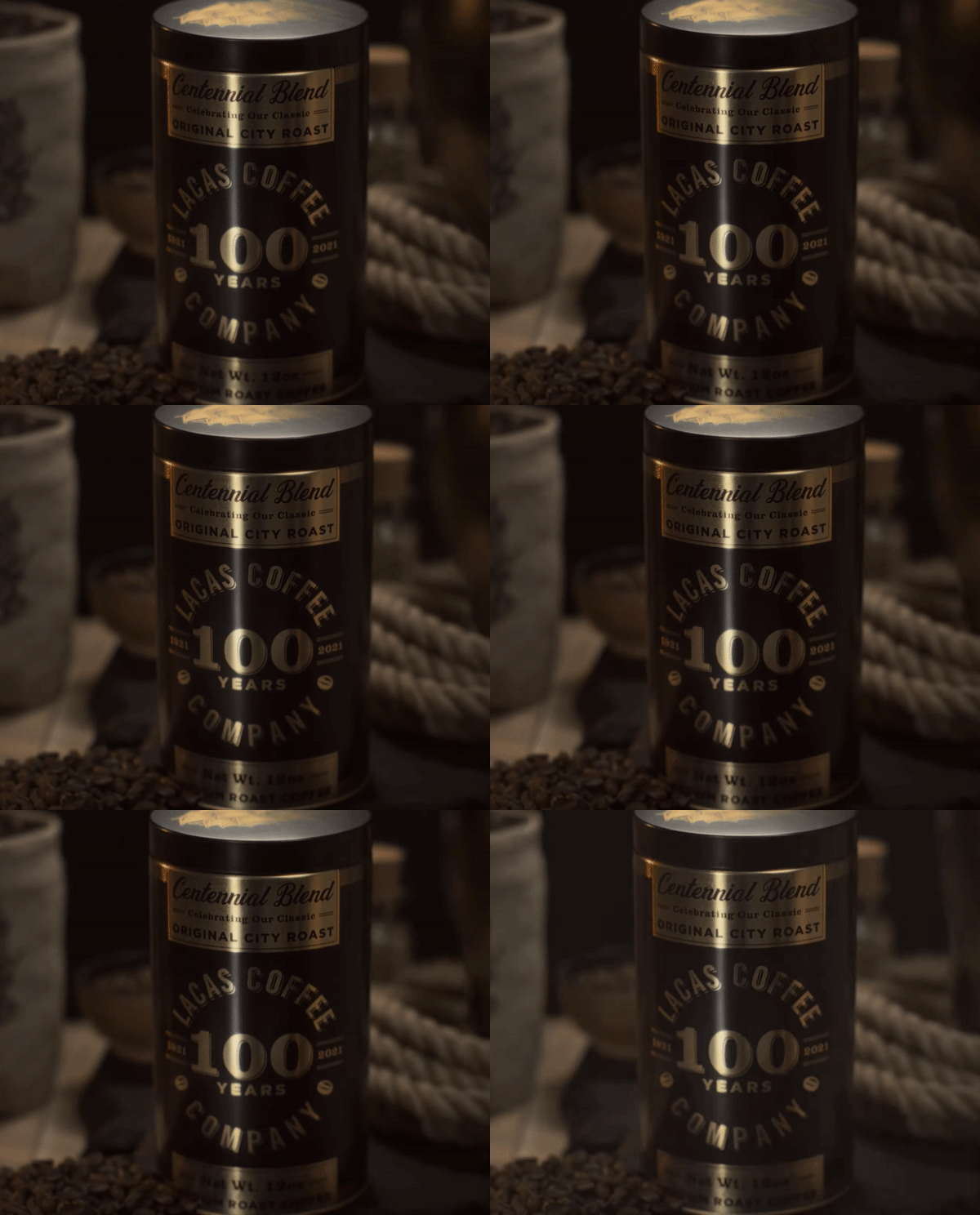
Lacas Coffee
Lacas Coffee
Credit Yak
Buy Your Swagg on POPOLOGIST®
The POPOLOGIST® Camera Slinger Video Game
POPOLOGY® Networks
1st POPOLOGIST® Pillow Swag
Science Under Nature
1st POPOLOGIST® Camera Slinger T Shirt
Color-Fuchsia Pink POPOLOGY® Underwear
Funky i Puppet

Updated: Oct 11, 2021


In POPOLOGICAL basements, garages, office towers and mini-malls everywhere,

unsung geniuses are toiling away on their latest, greatest inventions. Despite the obstacles they often face, these brilliant inventors remain passionate and unwavering in their ground-breaking pursuit to change the world. Tesla’s Children tells the story of five renegade inventors and their amazing inventions – one using moonlight to cure disease, and another using diamonds to power electronics! These mavericks are not only changing the existing scientific paradigm – they’re overturning it.


FULL LENGTH SHOW

MAD SCIENTIST

Attempting to develop inventions he could patent and market, Tesla conducted a range of experiments with mechanical oscillators/generators, electrical discharge tubes, and early X-ray imaging. He also built a wireless-controlled boat, one of the first-ever exhibited. Tesla became well known as an inventor and demonstrated his achievements to celebrities and wealthy patrons at his lab, and was noted for his showmanship at public lectures. Throughout the 1890s, Tesla pursued his ideas for wireless lighting and worldwide wireless electric power distribution in his high-voltage, high-frequency power experiments in New York and Colorado Springs. In 1893, he made pronouncements on the possibility of wireless communication with his devices. Tesla tried to put these ideas to practical use in his unfinished Wardenclyffe Towerproject, an intercontinental wireless communication and power transmitter, but ran out of funding before he could complete it.[9]

After Wardenclyffe, Tesla experimented with a series of inventions in the 1910s and 1920s with varying degrees of success. Having spent most of his money, Tesla lived in a series of New York hotels, leaving behind unpaid bills. He died in New York City in January 1943.[10] Tesla's work fell into relative obscurity following his death, until 1960, when the General Conference on Weights and Measures named the SI unit of magnetic flux density the tesla in his honor.[11] There has been a resurgence in popular interest in Tesla since the 1990s.


Asset ID 3cjGEiUcR2yKw1d1LDnLLjv6Jk9roMRRtfHfMvbRJq24

ree


ree

new POPOLOGIST® Member Kalix Sky

is a musician, philosopher, tech entrepreneur and designer. He is heading up his own NFT COLLECTIBLES and is making his wares known. Find him on DISCORD

( https://discord.gg/NFf3cx7t ) or his Twitter @Fibonaccis4. A stunning body of Non Fungible Tokens and much more. We hope Kalix will head up our NFT SALES when App Launches?


Updated: Oct 11, 2021


Nina Simone Speaks In This One Of A Kind Interview

What the youth of Black America need be aware of, and discover their culture of music, fashion, and human rights. Eunice Kathleen Waymon, known professionally as Nina Simone, was an American singer, songwriter, musical arranger, and civil rights activist. Her music spanned a broad range of styles, including classical, jazz, folk, R&B, gospel, and pop. Nina referred to her music as Black Classical Music.


The sixth of eight children born to a poor family in Tryon, North Carolina, Simone initially aspired to be a concert pianist.[1]With the help of a few supporters in her hometown, she enrolled in the Juilliard School of Music in New York City.[2] She then applied for a scholarship to study at the Curtis Institute of Music in Philadelphia, where she was denied admission despite a well-received audition,[3] which she attributed to racism. In 2003, just days before her death, the Institute awarded her an honorary degree.[4]

To make a living, Simone started playing piano at a nightclub in Atlantic City. She changed her name to "Nina Simone" to disguise herself from family members, having chosen to play "the devil's music"[3]or so-called "cocktail piano". She was told in the nightclub that she would have to sing to her own accompaniment, which effectively launched her career as a jazz vocalist.[5] She went on to record more than 40 albums between 1958 and 1974, making her debut with Little Girl Blue. She had a hit single in the United States in 1958 with "I Loves You, Porgy".[1] Her musical style fused gospel and pop with classical music, in particular Johann Sebastian Bach,[6] and accompanied expressive, jazz-like singing in her contralto voice.


After the success of Little Girl Blue, Simone signed a contract with Colpix Recordsand recorded a multitude of studio and live albums. Colpix relinquished all creative control to her, including the choice of material that would be recorded, in exchange for her signing the contract with them. After the release of her live album Nina Simone at Town Hall, Simone became a favorite performer in Greenwich Village.[28]By this time, Simone performed pop music only to make money to continue her classical music studies, and was indifferent about having a recording contract. She kept this attitude toward the record industry for most of her career.[29]

Simone married a New York police detective, Andrew Stroud, in December 1961. In a few years he became her manager and the father of her daughter Lisa, but later he abused Simone psychologically and physically.[3][30][31]

1964–1974: Civil Rights era

In 1964, Simone changed record distributors from Colpix, an American company, to the Dutch Philips Records, which meant a change in the content of her recordings. She had always included songs in her repertoire that drew on her African-American heritage, such as "Brown Baby" by Oscar Brown and "Zungo" by Michael Olatunji on her album Nina at the Village Gate in 1962. On her debut album for Philips, Nina Simone in Concert (1964), for the first time she addressed racial inequality in the United States in the song "Mississippi Goddam". This was her response to the June 12, 1963, murder of Medgar Evers and the September 15, 1963, bombing of the 16th Street Baptist Church in Birmingham, Alabama, that killed four young black girls and partly blinded a fifth. She said that the song was "like throwing ten bullets back at them", becoming one of many other protest songs written by Simone. The song was released as a single, and it was boycotted in some[vague] southern states.[32][33] Promotional copies were smashed by a Carolina radio station and returned to Philips.[34] She later recalled how "Mississippi Goddam" was her "first civil rights song" and that the song came to her "in a rush of fury, hatred and determination". The song challenged the belief that race relations could change gradually and called for more immediate developments: "me and my people are just about due". It was a key moment in her path to Civil Rights activism.[35] "Old Jim Crow", on the same album, addressed the Jim Crow laws. After "Mississippi Goddam", a civil rights message was the norm in Simone's recordings and became part of her concerts. As her political activism rose, the rate of release of her music slowed.


ree


Pay Per View Live Events
Fiverr
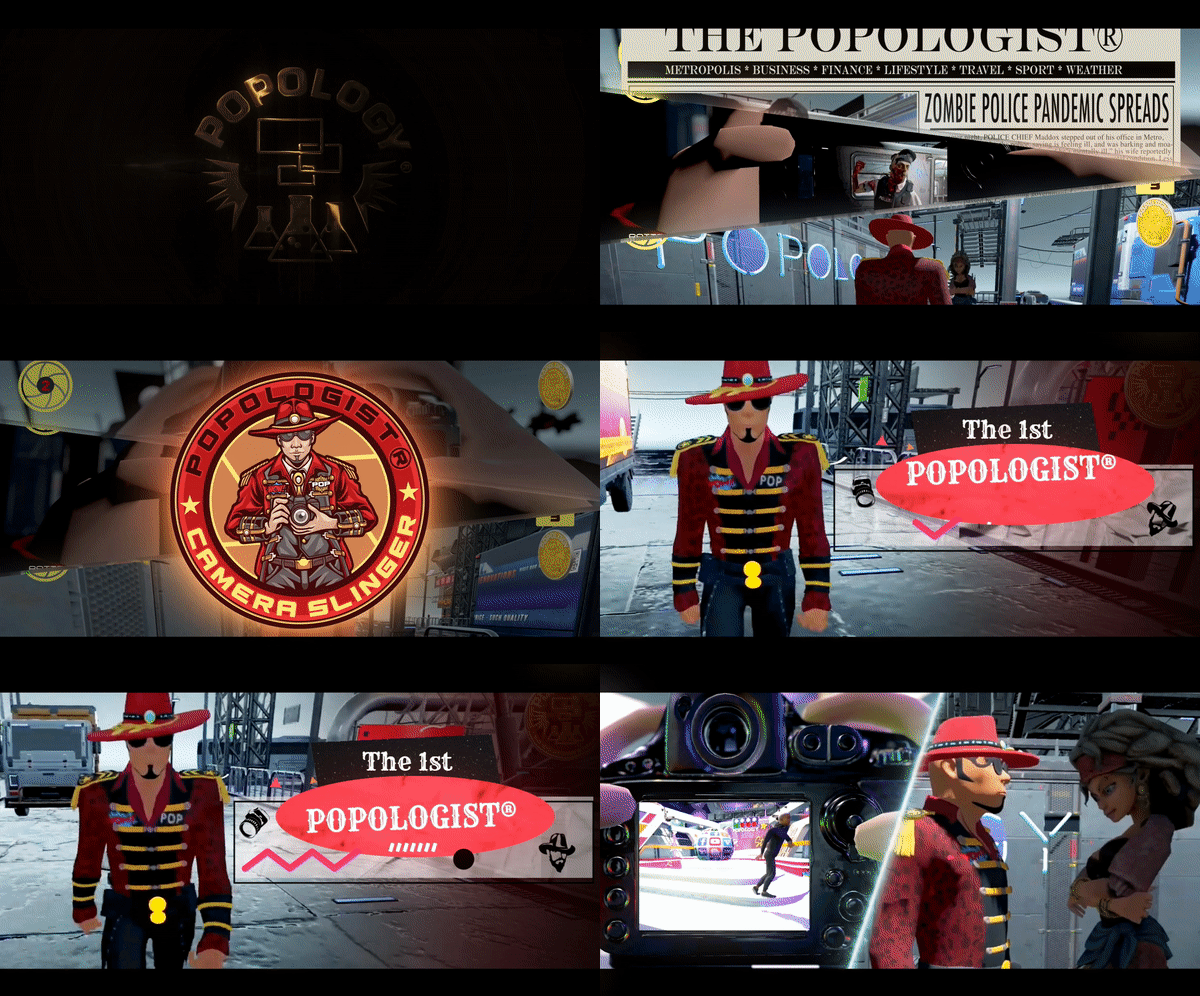
Join Steam buy the POPOLOGIST® Camera Slinger Video Game
Camera Slinger Promo
rBeatzRadio_Final (All) NEW-03.png
POPOLOGIST® Tim Bennett and his new Children's Book
The Adventures Of DogShoe & The Bakery Gang
POPOLOGIST® Coffee Mug
Black POPOLOGIST® Hoodie
Livestream Marathon
POPOLOGIST® White Coffee Mug
Guitar Center promoted on POPOLOGIST® Website
The 1st POPOLOGIST Camera Slinger Mascot

© 2024 COPYRIGHT  POPOLOGY® & POPOLOGIST®

215-880-5928

  • Facebook
  • Twitter
  • YouTube
  • Pinterest
  • Instagram
bottom of page